
About

Scientific evidence, innovation and creativity shape the way we work.
OUR APPROACH
We work across the UK with local authority health and social care teams, housing providers, and third-sector organisations to review, develop and implement learning, policy and guidelines for severe clutter, chronic disorganisation and hoarding disorder.
Our pioneering approach supports services to move beyond crisis-driven clearances towards collaborative, person-centred interventions that reduce risk, respect rights and support lasting behaviour change.
Grounded in implementation science and real-world constraints, we develop structured learning programmes, tools and frameworks that build confidence and competence across multidisciplinary teams. We focus on what practitioners can do differently to create safer environments and better outcomes for people affected by hoarding disorder.
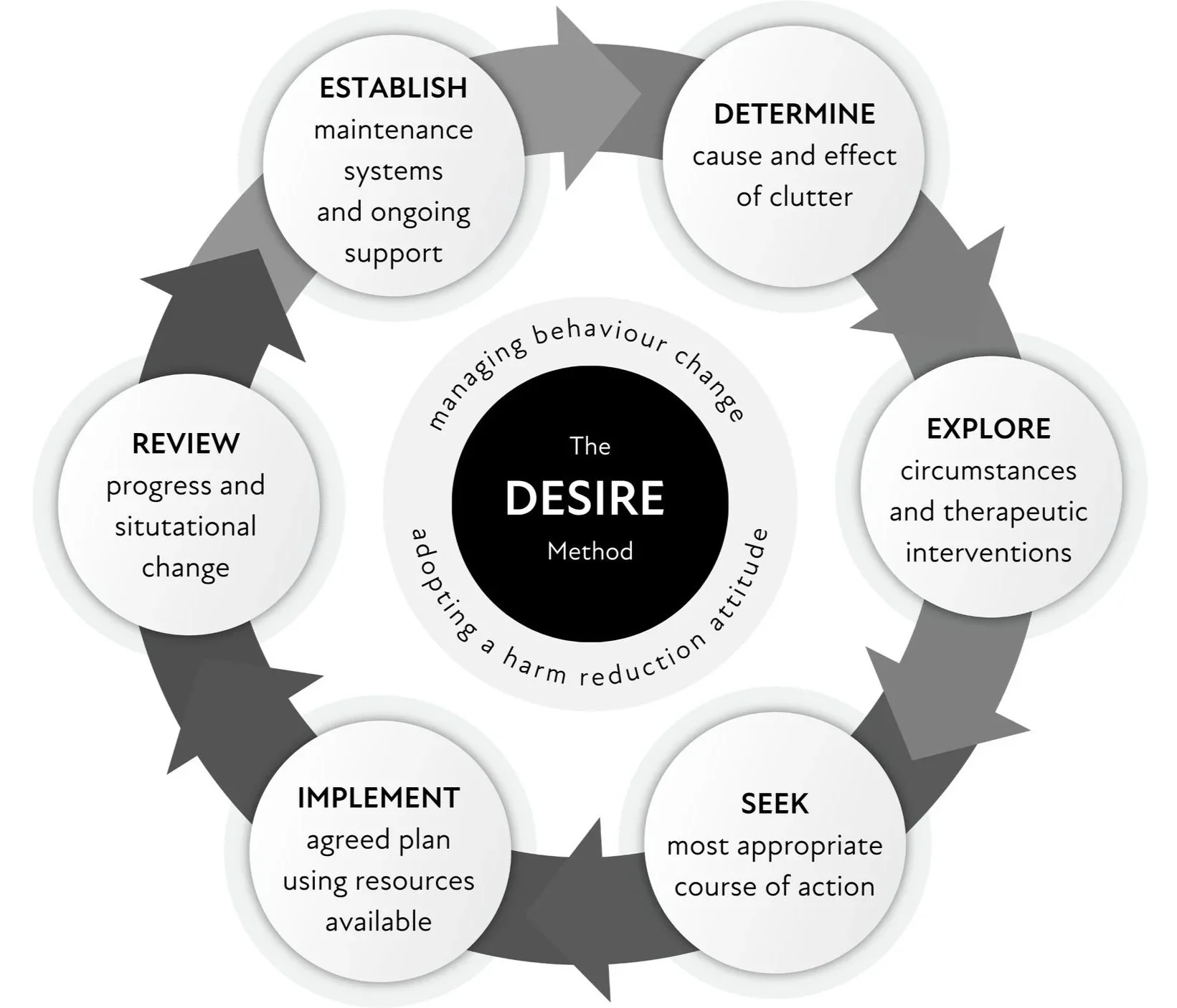
Our proprietary frameworks - the Hoarding Integrated Intervention Model and the DESIRE Method - sit behind all of our work, giving organisations a shared language and a structure for translating principles and ambition into action.
OUR FRAMEWORKS
The Hoarding Integrated Intervention Model™ (HIIM) brings together two interdependent domains of practice:
Practical intervention focuses on Assessment - risk, context, motivation and readiness evaluation, Prioritisation and planning - collaborative goal-setting, Organising and decluttering - hands-on environmental intervention, and Relapse prevention - sustainable strategies for maintaining progress
Therapeutic intervention focuses on motivation, engagement and emotional attachment, drawing on motivational interviewing, cognitive and behavioural principles, harm reduction, trauma-informed and strengths-based approaches. These techniques support readiness for change and help reduce distress, avoidance and disengagement.
Neither domain is sufficient in isolation. The model recognises that practical action without therapeutic engagement is rarely sustained, while therapeutic work without practical change stalls.
The DESIRE Method is the operational pathway
OUR HISTORY
A NOTE FROM OUR FOUNDERIn 2013, I established Life-Pod CIC and led the organisation to become a valued service provider that grew to become a team of 14 specialist practitioners. Sadly, in 2024, due to financial constraints and commissioning restrictions, I had to make the very difficult decision to close the organisation.
As an eternal optimist, and in my endeavour to turn a negative into a positive, I decided to establish Hoarding Academy and at the same time undertook an MSc in Behaviour Change at Aberystwyth University in Wales. I graduated in July 2026 having achieved a Distinction for my dissertation: A qualitative study involving housing support practitioners and using behavioural theories to examine the use of low value care hoarding interventions and identify opportunities for de implementation.
Life-Pod was the start of my journey in this field and where I developed my practice-based evidence. Hoarding Academy is where I complemented that with evidence-based practice and reflective learning practice. All of which enabled me to develop practice frameworks - the Hoarding Integrated Intervention Model™ and the DESIRE Method™ that I apply to all of my work.
HIIM is grounded in contemporary behaviour change theory and informed by safeguarding principles and human rights considerations. Emphasis is placed on least-restrictive, proportionate intervention, balancing risk management with dignity, autonomy and compassion.

Let’s have a conversation about how Hoarding Academy can help you and your organisation to put theory into practice. Get in touch - I’d love to hear from you.
HOARDING TASKFORCE (SCOTLAND)
In 2024, in collaboration with Iriss (the Institute for Research and Innovation in Social Services), the Hoarding Taskforce in Scotland was established. I am a founding member and provide advice and guidance for multi-disciplinary professionals on learning, policy, practice and how best to manage hoarding-related situations.
UK HOARDING PARTNERSHIP
In 2025, I joined the steering committee for the UK Hoarding Partnership – a group of professionals drawn from diverse organisations including, local authorities, housing associations, emergency services, NHS, third sector organisations, etc., who have an interest in hoarding and how to help individual’s with lived experience.